Mastering the Omnichannel Matrix: Why Modern Retailers Must Align Email and SMS Strategy

The modern retail landscape has fundamentally transformed how brands communicate with their consumer base, shifting from broad, scattershot advertising to highly localized, deeply personal digital touchpoints. When a consumer willingly provides a mobile telephone number at a digital or physical point of sale, they are not merely completing a transaction; they are granting direct access to their personal devices—specifically, the lock screen of a smartphone that remains within arm’s reach throughout the day and night. Industry analysts have long noted the stark contrast between digital communication mediums: while an email inbox functions much like a public postal corridor where messages accumulate quietly, a mobile phone number operates as a direct entry into a consumer’s private space.
Historically, many company founders and marketing directors have struggled to differentiate the utility of these two distinct channels. Often, organizations adopt a binary approach, treating email and SMS as interchangeable tools or neglecting one entirely in favor of the other. Email is frequently selected due to its cost-effectiveness and familiarity, whereas SMS has gained rapid traction primarily due to extraordinarily high open rates observed across early adopters. However, relying exclusively on either channel creates significant operational inefficiencies, leaving both potential revenue and customer goodwill untapped on the table.
The Evolution of Direct-to-Consumer Digital Marketing
To understand the current imperative for unified omnichannel marketing, one must examine the rapid maturation of direct-to-consumer (DTC) digital strategies over the past decade. In the early days of e-commerce, email marketing reigned supreme as the primary vehicle for customer retention and promotional broadcasting. As inboxes became increasingly saturated with promotional material, average open rates steadily declined, prompting marketers to seek alternative, high-visibility channels.
The subsequent rise of SMS marketing in the late 2010s offered a revolutionary breakthrough. With read rates frequently exceeding 90 percent within the first three minutes of delivery, text messaging provided an unprecedented mechanism for cutting through digital noise. Yet, the rush toward mobile messaging introduced new complications. Without rigorous frequency capping and strategic message allocation, brands quickly discovered that indiscriminate text messaging prompted rapid subscriber fatigue, culminating in high opt-out rates and permanent damage to brand equity.
By 2023 and 2024, digital marketing consensus shifted decisively toward integration. Industry benchmark studies published by customer engagement platforms emphasize that brands utilizing synchronized multi-channel strategies—specifically combining email and SMS within automated sequences—experience conversion rates up to 250 percent higher than those relying on single-channel campaigns. This empirical data underscores the necessity of moving away from siloed communication tactics toward a cohesive, choreography-driven messaging framework.
The Strategic Dichotomy: Inboxes Versus Lock Screens
To execute a successful omnichannel strategy, marketing executives must carefully analyze the psychological and functional differences between email and SMS, ensuring that each medium is deployed in alignment with its inherent strengths.
Email remains the definitive medium for long-form storytelling, comprehensive product education, and detailed brand narrative development. Because inboxes are built to accommodate vast amounts of information without immediate intrusion, email allows brands to showcase high-resolution imagery, elaborate on product origins, and segment audiences based on granular historical purchase data. The primary drawback of email is its asynchronous nature. Messages frequently sit unread for hours—or days—amidst dozens of competing notifications, making the channel ill-suited for time-sensitive announcements.
Conversely, SMS is characterized by immediacy, brevity, and high-stakes urgency. Constrained by character limits and accompanied by an intrusive auditory or haptic alert, a text message demands immediate cognitive attention. Because every SMS segment incurs direct financial cost and carries a high risk of perceived annoyance, the channel must be reserved exclusively for communications that possess a definitive expiration time. Flash sales ending at midnight, real-time back-in-stock alerts for high-demand inventory, and abandoned cart reminders sent while purchase intent remains critically high represent the optimal utilization of mobile messaging.
Chronology and Sequence: The Blueprint for Automated Workflows
A common operational error observed among emerging e-commerce brands is the simultaneous deployment of multi-channel triggers. Firing an email and an SMS at the exact same second for the same trigger event—such as a welcome discount or an abandoned cart—does not double the persuasive impact; rather, it creates channel fatigue and wastes valuable marketing budget.
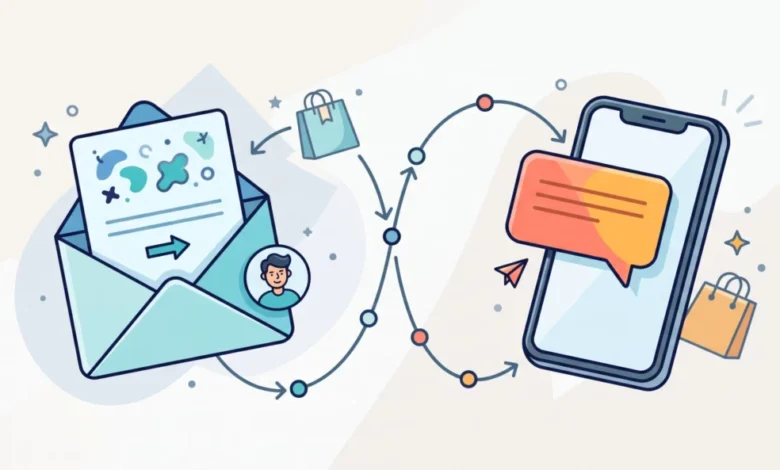
Industry experts advocate for a staggered, sequential approach to customer journeys. Modern marketing automation platforms—such as Omnisend, Klaviyo, and Attentive—allow brands to orchestrate complex, multi-channel workflows from a single operational dashboard. Under a best-practice sequence, the welcome journey begins via email, leveraging the broader format to introduce the brand’s core mission, product catalog, and initial promotional incentive. If the subscriber fails to engage or complete a purchase within 24 to 48 hours, a concise, single-segment SMS is deployed as a strategic nudge.
A similar methodology governs abandoned cart sequences. The initial notification is delivered via email, providing a detailed visual summary of the left-behind items alongside customer service reassurance. If the digital shopping cart remains active several hours later, a short-form text message serves as a timely bridge to checkout, capturing impulse buyers before purchase intent dissipates entirely.
Specialized events, such as the peak Black Friday and Cyber Monday (BFCM) shopping window, demand even greater restraint. While email volume naturally intensifies during high-stakes retail holidays to manage the campaign build-up, SMS cadence should be strictly preserved for high-impact milestones, such as sale launch announcements and final countdown hours. This disciplined approach protects the longevity of the mobile subscriber list.
Economic Implications and Consumer Trust
The financial implications of mismanaged mobile marketing are substantial. According to recent retail data, acquiring a mobile subscriber involves significant customer acquisition costs (CAC). Losing that subscriber to an avoidable opt-out request represents both an immediate financial loss and the permanent forfeiture of a brand’s most effective direct-response channel.
Regulatory frameworks, including the Telephone Consumer Protection Act (TCPA) in the United States and stringent GDPR and PECV guidelines in Europe, impose strict legal compliance standards on SMS marketing. Beyond legal mandates, however, unwritten social contracts dictate the sustainability of mobile communication. Industry specialists consistently advise maintaining rigorous consent protocols, honoring regional quiet hours, and ensuring that opt-out mechanisms remain seamless and immediate.
Brands that exercise strategic restraint frequently observe higher customer lifetime value (LTV) and superior retention metrics. By viewing SMS consent as an invitation into a consumer’s private digital space rather than a license for relentless broadcasting, companies foster long-term loyalty and sustainable revenue growth.
Future Outlook for Omnichannel Integration
As artificial intelligence and machine learning continue to reshape predictive consumer analytics, the capacity of marketing platforms to dynamically route messages between email, SMS, and web push notifications will become increasingly sophisticated. Future iterations of automated workflows will leverage real-time behavioral data to determine not only what message to send, but precisely which channel an individual user prefers for specific types of communication.
Ultimately, the maturation of omnichannel marketing represents a return to fundamental principles of respectful, customer-centric communication. By aligning technological capabilities with psychological boundaries, modern enterprises can eliminate channel redundancy, optimize marketing expenditures, and build resilient digital relationships that endure well beyond the initial point of sale.